(1) The Watt’s towers from Sabato ‘Sam’ Rodia
Sabato Rodia (1876-1965) arrived from Italy in the USA at 15 years of age, to join with his older brother who had immigrated earlier. In the USA people named Sabato ‘Sam’, or – according to some – ‘Simon’. When his brother died in a mining accident in Pennsylvania, where they lived and worked in quarries and as construction worker, Sam Rodia moved to Seattle. Here he married with Lucia Ucci and got three children, of whom one died. The couple separated 10 years later.
He then came to work as tile setter in California. There, in 1921, he achieved a piece of land in the community of Watts, part of Los Angeles, which he called “Nuestro Pueblo” (Our Town or Village). In his spare time he raised a wall and within the encircled space started to create an assembly of seven large towers, in themselves assemblages, of steel rebar and concrete with mosaics from tiles, broken ceramics, shells, and glass bottles. To these towers he added pavilions, fountains and benches. The structures were coated with decorations in the shape of work tools, fruits and vegetables. Everything was done with simple hand tools and without the use of scaffold.
Rodia welcomed visits from members of the neighborhood and several marriage and other celebrations are said to have taken place under the towers. Motive for the building of these towers reportedly were, that he wanted to be engaged in a healthy and lasting project.

Watt’s Towers – Overview 1, photo by Michael Czerwonka, photo as this appeared in NY Times Feb 7, 2011, with permission
Sam Rodia continued to work on the towers for over 25 years and then in 1954 he gave the lot to his neighbour and left to live elswhere. In 1959 two young film makers heard of the threat by local authorities to demolish the towers on the presumption these were a hazard. They – with other young artists – set up a Committee for Simon Rodia’s Towers in Watts, that despite lack of grand names succeeded in preserving the towers for the future. After proof was obtained that the towers were safe the Watt’s Towers were listed as national heritage in 1965 and 10 years later became an art center for the city.
Already around 1960 recognition came that Rodia had made a special art assemblage, from art professionals in academia. Yet, he died in Martinez without returning to Watts in 1954.
While preparing this essay, I encountred many nice photo’s on flickr. Some have been posted here (with permission) but I give you the consideration to follow the links yourself. One image from a scale model of the Watt’s Towers that was made by the architect Larry Harris – I think – enhances the perception of the project as you can see below.
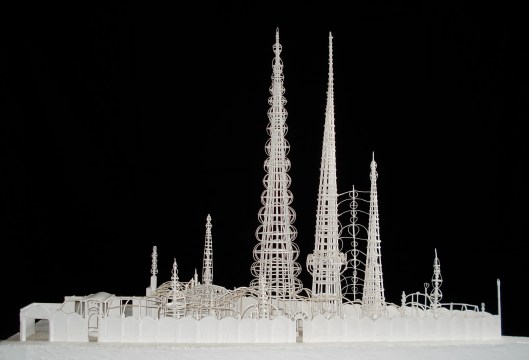
Larry Harris – Scale Model of Watt’s Towers (1996-1997), from flickr, with permission
Details of the collage – assemblage art as created by Sam Rodia by use of parts of tiles, bottles etcetera, are seen in the following three images.

Watt’s Towers – detail 1, photo by Stephen Silverman, with permission (see album on http://www.flickr.com)

Watt’s Tower – detail 2, photo by Stephen Silverman, with permission
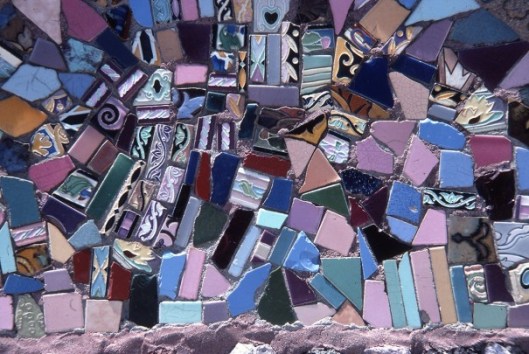
Watt’s Towers – detail 3 (tiles), by photo by Seymour Rosen (ca.1976), SPACES – Saving and Preserving Arts and Cultural Environments (www.spacesarchives.org), with permission
In 1962, the committee for Simon Rodia’s Towers in Watts, mentioned above, formed the Watts Tower Cultural Center that would offer art classes and exhibitions in which local inhabitants could take part. With the arrival in 1964 of Noah Purifoy as the first black director of the center, the committee hoped to realize a nucleus for community-based art in Watts. This community had changed much in demography following World War Two, after the influx of many African-Americans into this – in former years predominantly Mexican-populated area – and which at that time was economically depraved. A few years later these poor social circumstances were at the basis of major disturbances.
(2) The Watt’s rebellion
The African American artist Noah Purifoy (1917-2004) was teacher at this Watt’s Towers Art Center in 1965 when an arrest of a black motocyclist by a white policemen, – considered as injust by onlookers -, led to riots. These riots can be seen as result of long-term neglect, oppression and feeling by Watt’s inhabitants of injustice from the side of authorities. Between the 11th and 19th August hundreds of stores were looted, cars and buildings burned. After intervention of a large force of the National guard, 34 people were dead, over 1000 thousand injured and economic damage assessed as over 40 million USD. (Take some time and read extended testimony from artists like John Outterbridge in ref. 3).
Noah Purifoy saw the massive collective violance and together with fellow artists started collecting debris and rubble spread on the streets in the first days after violence started.
From the debris he and seven fellow artists (Judson Powell, Arthur Secunda, Gordon Wagner, Max Neufeldt, Ruth Saturensky, Debby Brewer) collected, they constructed assemblages / installations, collectively named 66 Signs of Neon, that were fitted from “fire-molded wood collided with smashed-in windows, burnt railroad-ties with scorched steel” (writing by Yael Lipschutz). The artists by use of this material originating from destruction, created an echo of the rebellion and an appeal to be constructive. From the resulting art-works the artists formed a landmark group exhibition about the rebellion that traveled to nine venues between 1966 and 1969. This exhibition was in line with the increased attention for street art and – life in photography and creative art and for the approach by people like Marcel Duchamp to transfer found objects into art.
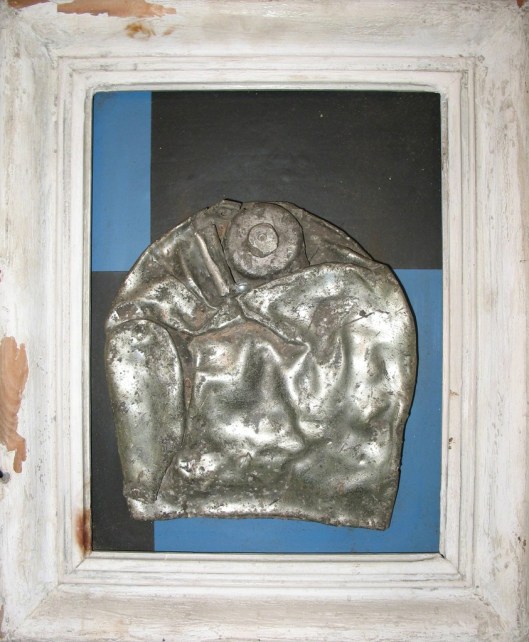
Noah Purifoy – Pressure, c1966. A metal can scathed by the fire during the ‘Watt’s riots. the pereception of destruction is enhanced by putting this found object in the white frame. Image found at website from the Hammer Museum (www.hammer.ucle.edu), posted with permission of the Noah Purifoy Foundation
(3) The Watt’s Tower Art Center
Noah Purifoy had a professional training in social work and had a strong belief in the healing power of art education. In an interview with Richard Cándida Smith, the artist shared his strong motive:
“Within [each person] there’s a creative process going on all the time, and it’s merely expressed in an object called art. One’s life should also encompass the creative process. We were trying to experiment with how you do that, how you tie the art process in with existence” (referred to in ref 4).
With his colleague Judson Powell and with a basis at the Watt’s Tower Art Center, they were determined to increase perspectives for – in particular younger – people of Watts. With their belief that art could transform consciousness, and with the artworks created from found debris, it was to become clear that creativity can be exploited by use of the cheapest material.
In following years, Purifoy as chair of a committe of education in LA instigated a state-supported art in education program “California Learning Design – that ran at nine schools in the state. Artists were employed half-time for one year at such a school and together with regular teachers they shaped a program of teaching into which students, artists, and the community came to interact by physically ‘mixing these elements’.
(4) Noah Purifoy in Joshua Tree

Noah Purifoy Outdoor Desert Art Museum of Assemblage, Sculpture <Welcome> photo by Ed Glendinning (#48-15), found at http://www.edglenphoto.com, with permission
In the late 1980’s, after eleven years of public policy work for the California Arts Council, where Purifoy initiated programs such as Artists in Social Institutions, bringing art into the state prison system, Purifoy moved his practice to the Joshua Tree in the Mojave desert. He lived there for the last fifteen years of his life, while lacking a pension – and created ten acres of large-scale sculpture constructed entirely from junked materials. The members of the surrounding community as well as entrepreneurs gave him discarded material, or gear that (legally) no longer was accepted in construction. The large scuptures he made, were meant to communicate with the environment, both nearby as well as the landscape at distance. The wear-and-tear of heat / cold plus strong wind became part of the time-line of the assemblages. (See images and the movie on vimeo (https://vimeo.com/397505164).

Noah Purifoy Outdoor Desert Art Museum of Assemblage – Sculpture, photo by Ed Glendinning (# 12-15), with permission

Noah Purifoy Outdoor Dsert Museum of Assemblage – Sculpture, photo by Ed Glendinning (#16-15), with permission.
The large scuptures Noah Purifoy made in the Joshua Tree Desert, were meant to communicate with the environment, both nearby as well as the landscape at distance….
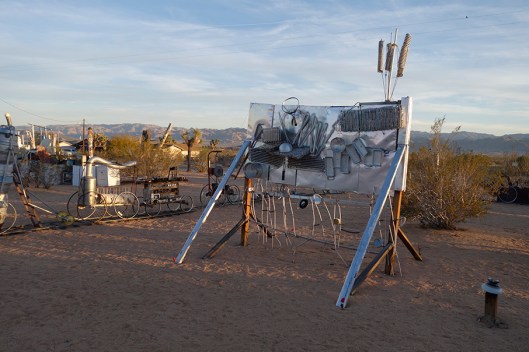
Noah Purifoy Outdoor Desert Art Museum of Assemblage – Sculpture, photo by Ed Glendinning (#38-15), with permission
As written in Richard Cándida Smith article (“Learning from Watt’s Towers: Assemblage and Community-based Art in California”): “One plumbing contractor donated several dozen toilets that could no longer be installed in California due to changed water-conservation law.”

Noah Purifoy Outdoor Desert Art Museum of Assemblage – Sculpture, photo by Ed Glendinning (# 18-15), with permission
And, the last photo chosen by me – being interested also in (abstract) collage, and which might underscore the interest Noah Purifoy had in art from the Dutch painter Mondrian…

Noah Purifoy Outdoor Desert Art Museum of Assamblage – sculpture (collage), photo by Ed Glendinning (#11-15)
(5) Notes:
(a) In February 2016 (running till August) it was memorized that 50 years ago the Watt’s rebellion took place under the event title “50 years later and I still can’t breath”.
(b) citations provided with permission by respective authors.
(text by Mrs Yael Lipschutz accessed in September 2015, no longer available at the internet as far as I could see by search on July 31st 2016.)
(c) There is still need to support the preservation of the Watt’s Towers. Let us hope support from LA City will be stronger in the next year. http://spacesarchives.org/blog/2016/03/25/act-now-support-the-watts-towers-candidacy-for-unesco-world-heritage-site-status/
(6) Advise for further reading:
For more views and images of the Watt’s Towers and the Noah Purifoy Outdoor Dserert Art Museum of Assemblage Sculpture visit the links containing texts and many more photographs:
(1) Thomas Pynchon. “” A Journey into the Mind of Watts”, NY Times June 12, 1966 http://www.nytimes.com/books/97/05/18/reviews/pynchon-watts.html?_r=1
(2) Richard Cándida Smith. “Rodia, Simon“; http://www.anb.org/articles/17/17-01372.html; American National Biography Online Feb. 2000.
Copyright © 2000 American Council of Learned Societies. Published by Oxford University Press.
(3) Richard Cándida Smith. “Learning from Watts Towers: Assemblage and Community-based Art in California” Oral History, Autumn 2009: pp 49-56. http:// history.berkeley.edu/sites/default/files/Learning%20from%20Watts%20Towers.pdf
(4) Richard Cándida Smith. “The Modern Moves West: California Artists and Democratic Culture in the Twentieth Century”. University of Pennsylvania Press, Philadelphia, 2009, on Rodia: pp 45-54, on Purifoy: pp 154-181.
(6) Cameron Shaw. “Make Art not War. Watts and the Junk Art Conversation”, November 2010, East of Borneo. http://www.eastofborneo.org/articles/make-art-not-war-watts-and-the-junk-art-conversation
(7) Thomas Harrison. “Without precedent: The Watt’s Towers”, California Italian Studies 1, 2010. http://escholarship.org/uc/item/3v06b8jt
(8) Adam Nagourney. “A hidden treasure struggles in Los Angeles“, NY Times, Feb 7, 2011. http://www.nytimes.com/2011/02/08/us/08watts.html?_r=0
(9) Rubén Martínez. “Assembly required: the desert cure – the transformative art of Noah Purifoy”. Boom: A Journal of California, vol 2, Summer 2012. http://rubenmartinez.la/wp-content/uploads/2012/11/Boom-Purifoy-Column1.pdf
(10) Tanja M. Laden: “Junk Dada: The stories behind Noah Purifoy’s Joshua Tree Sculptures”, September 2015; http://www.kcet.org/shows/artbound/junk-dada-the-stories-behind-noah-purifoys-joshua-tree-sculptures
(11) Julia Felsenthal. “Noah Purifoy’s “Junk Dada”is an Art Show for the Post-Ferguson World”, June 15, 2015. http://www.vogue.com/13270774/noah-purifoy-lacma-junk-dada/
(12) Katie Grinnan. “Material Communication: Noah Purifoy at LACMA”. X-tra Contemporary Art Quarterly, Spring 2016, Vol. 18, no 3. http://x-traonline.org/article/material-communications-noah-purifoy-at-lacma/
Please also visit:
http://www.lacma.org/sites/default/files/Noah-Purifoy-Media-Advisory-2.4.15.pdf
http://www.wattstowers.org/
http://www.wattstowers.us/
http://noahpurifoy.com
http://www.cityprojectca.org/videos: several movies about the importance to save the Watt’s Towers.
http://www.edglenphoto.com
http://www.spacesarchives.org




 drager-meurtant