In Kunsthaus, Zürich, Switzerland a remarkable exhibition is held from February 1st to May 1st, 2016.One-hundred years after one of the founders of DaDa, Trstan Tzara, aimed to create a book “DadaGlobe” with contributions from many dada artists, a reconstruction has been accomplished.
Background
With the 19th century increase in industrialisation and in migration to cities plus the enhanced nationalism in Europe and elsewhere there was more tension in society, which was also articulated by artists such as the ‘futurist’ Filippo Tomasso Marinetti. The call to get rid of existing structure in language and art by art movements like futurism, and in different direction, by kubism, anticipated Dadaism.
At the start of WW-One, several artists who had fled from being drafted into the military or were resident in Zürich assembled in a movement of protest in this city in Switzerland. They detested the role of the establishment / authorities who were responsible for – as Richard Huelsenbeck later, in 1920, wrote – “the massing <of> men in the trenches of Northern France and giving them shells to eat”.
Hans (or Jean) Arp came from the Elsace, a repeated playground for German and French nationalistic frenzy. With Hugo Ball and Richard Huelsenbeck, both german, and the rumenian Tristan Tzara and Marcel Janco they founded Dada at Cabaret Voltaire, a small theatre started in February 1915 by Hugo Ball and his friend Emmy Hennings.
A prominent feature of dadaist aesthetic was its ridicule of materialistic and nationalistic stance, and it was expressed in poetry, prose, painting, sculpture and performance. The mediums of collage and of assemblage, that had surfaced a while earlier, were embraced with ardor.
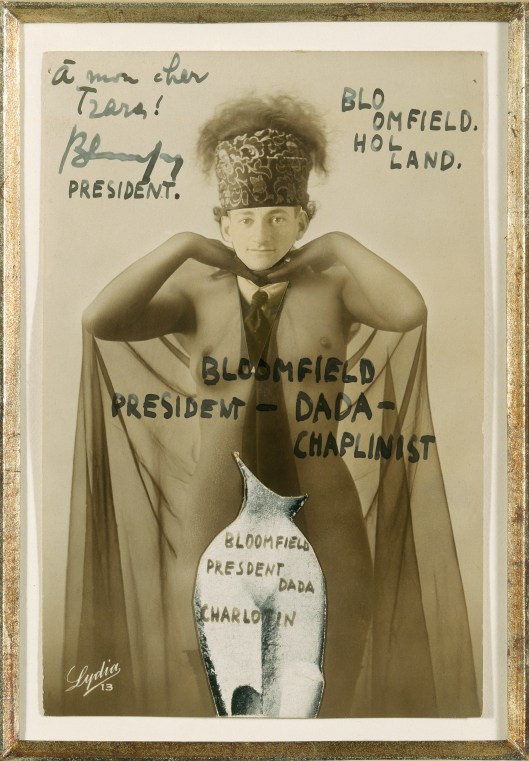
Erwin Blumenfeld: “Bloomfield, President-Dada-Chaplinist”, 1921
Collage mit braun-getönten Silbergelatine-Fotoausschnitten (Portrait Blumenfelds) über Silbergelatine-Foto-Aktpostkarte, mit Rasterdruck und Tinte, 13,4 x 8,8 cm
Kunsthaus Zürich, © Nachlass Erwin Blumenfeld
While often seen as the first vocalization of babies, the word Dada – as the dadaists tried to explain -, means nothing or everything. As Hugo Ball mentioned “All the words are other people’s inventions. I want my own stuff, my own rhythm, and vowels and consonants too, matching the rhythm and all my own” (first Dada soiree, Zürich 14th July 1916). Later attributions are that the word Dada comes from French, from a children’s word for hobbyhorse, the name being arbitrarily chosen, or from romenian da-da meaning yes-yes (https://en.wikipedia.org/wiki/Dada)
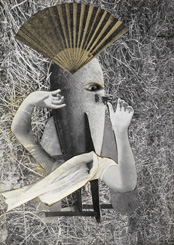
Max Ernst, Chinesische Nachtigall, 1920, Collage und Tusche auf Papier, 12,5 x 9 cm, Musée de Grenoble, © 2016 ProLitteris, Zürich
A major force in Dada was Tristan Tzara. Exemplary is his statement about poetry:
TO MAKE A DADAIST POEM
Take a newspaper. / Take some scissors. / Choose from this paper an article of the length you want to make your poem. / Cut out the article. / Next carefully cut out each of the words that makes up this article and put them all in a bag. / Shake Gently. / Next take out each cutting one after the other.
Copy conscientiously in the order in which they left the bag. /
The poem will resemble you. / And there you are—an infinitely original author of charming sensibility, even though unappreciated by the vulgar herd.
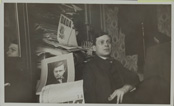
Unbekannter Fotograf: Portrait von Tristan Tzara, um 1920
Silbergelatineabzug, 11,4 x 18,6 cm, Collection Chancellerie des Universités de Paris, Bibliothèque littéraire Jacques Doucet, Paris
(The following paragraph is taken from the press briefing by Kunsthaus Zürich)
100 ARTWORKS, 100 DOCUMENTS
With contributions by artists and writer s from seven countries, many of whom created new works for his publication, co-founder of Dada and originator of the ‘Dadaglobe’ project Tristan Tzara (1896-1963) set out to present the apotheosis of Dada as a literary and artistic movement of international scope and to document it for posterity. ‘Dadaglobe’ was envisaged as a paean to the work of art in reproduction; but financial and organizational difficulties meant that the book never saw the light of day. The result is a void where a magnum opus should be – at the heart of Dada’s reception and the artistic production of the avant-garde in general. Now, a hundred years after the foundation of Dada, an exhibition and a comprehensive publication aim to fill that void. ‘Dadaglobe Reconstructed’ turns the analytical spot light on this notoriously restless and virtually unclassifiable art movement. It writes a fundamental, hitherto missing chapter in the history of modernism, in which Tzara’s Dada legacy shapes the vocabulary of artistic discourse.

Raoul Hausmann, P, um 1920-1921 Collage mit bedrucktem Papier und Tinte, 31,2 x 22 cm Hamburger Kunsthalle, Kupferstichkabinett © 2016 ProLitteris, Zürich
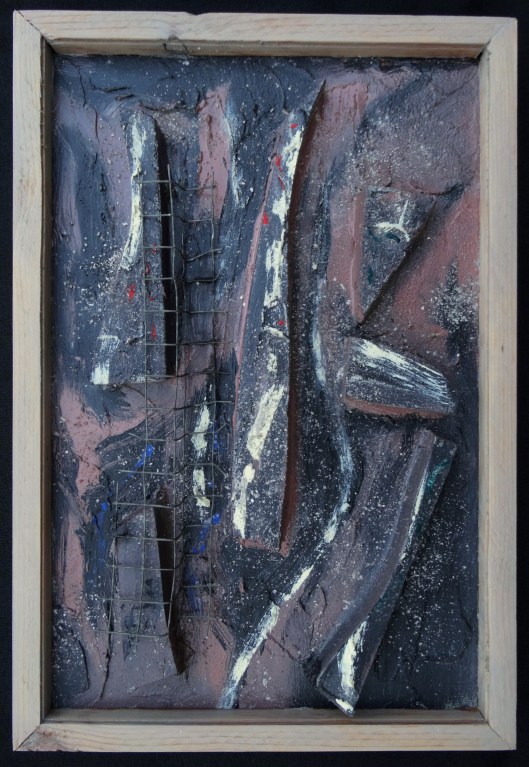
To honor the Kunsthaus curators and contributing artists / musea / collections with the establishment of the DadaGlobe Reconstruction, I will contribute – on the worldpress webpage only – my assemblage “Kaleidokopus”

Paleidokopus: the movement / is slantwise / cautious / and under guidance. // Threat can come / from all sides. // Fear feeds mania, / and reason / does not allay / thirst.
Assemblage, wood, metal, paint, 38 x 23 x 53cm, © drager meurtant, 2014 (more at http://www.meurtant.exto.org)
Literature:
Richard Huelsenbaeck: En Avant Dada: A History of Dadaism, 1920, in Robert Motherwell, editor, The Dada poets and painters, Anthology, 2nd ed. Belknap, Harvard University Press, Massachusetts, London, 1951.
Dada and Surrealism: Texts and Extracts. http://pers-www.wlv.ac.uk/~fa1871/surrext.html
Samantha Kavky: Max Ernst’s Post-World War I Studies in Hysteria; The Space Between Volume VIII:1 2012 pp 37-63, http://www.monmouth.edu/the_space_between/articles/SamanthaKavky2012.pdf
Acknowledgement: the author thanks Kunsthaus Zürich for enabling use of text and images in this blog.
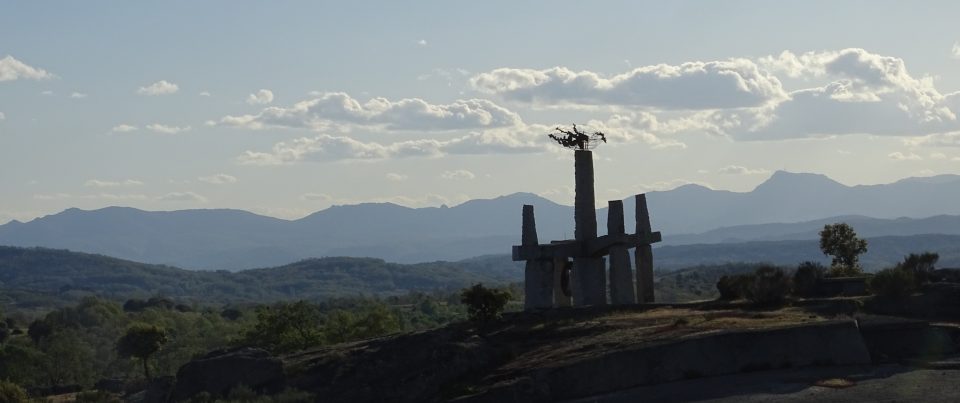




 drager-meurtant