
The relevancy of art or artists
In Hyperallergic (digital newsletter) a comment was written by Jillian Steinhauer with the title “Behold Nazi Postcards from the Infamous Degenerate Art Show” on November 26, 2014
(see: http://hyperallergic.com/165346/behold-the-nazi-postcards-from-the-infamous-degenerate-art-show/)
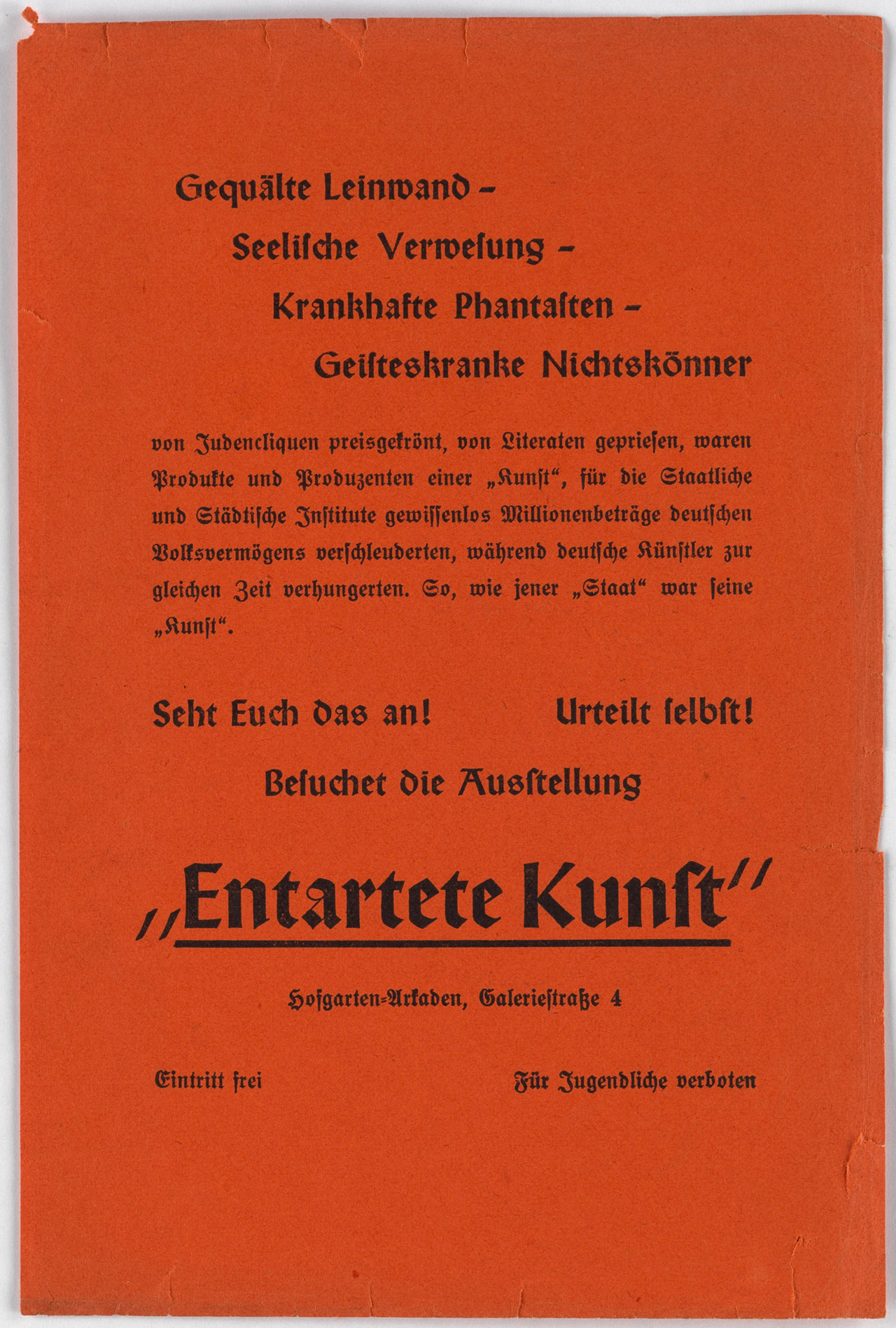
Jillian Steinhauer reacts to an announcement* of the auction of items from the Interbellum, namely 5 postcards displaying art as shown at the exhibition Entartete Kunst in München and other German and Austrian museums in 1938 plus 5 photographs of moments during the opening of one of these exhibitions and a poster (broadside).
*“The Degenerate Art Show postcards, broadside, and photographs will be sold together, as lot 133, in Swann Auction Galleries’ Vernacular Imagery, Photobooks, & Fine Photographs sale, on December 11, 10:30am.”
The author rightfully states that the viewer must look beyond an innocent display or surface, that postcards often present, since here the dark meaning of the views and subsequent action of the nazi authorities is not outspoken.
The postcards, the essay tells, were “apparently shot by Heinrich Hoffmann, Hitler’s chief photographer, (and) are notably simple: three of them show individual “degenerate” artworks, one the building’s exterior, the last an installation view.
Jillian Steinhauer adds “The Nazis, one supposes, fell into the usual trap: they expected everyone to see it their way, no added explanation or convincing necessary. These disgusting, offensive artworks would speak for themselves. Today they still do — only they’re telling a vastly different story.

photo of art on display in Berlin at one of the exhibitions on “Entartete Kunst”
– – – – – – – – – – – – – –
Drager Meurtant is rather allergic to trends and powers in current society pushing artists to be politically correct. Having seen several expositions in 2014 memorizing art in Wold War One and the developments in the so-called Weimar Republic and subsequent take-over by nazis, he commented to the posting in Hyperallergic:
“With time, every wound will come to it’s end, leaving a scar, an income to reconstructive surgeons, or a dead body. we visited a remarkable exhibition in Soest (Museum Wilhelm Morgner, Sauerland, Germany) placing art (that had not been destroyed) by ‘Entartete Künstler” opposed to some artists that were enthousiastic followers of the NSDAP. The latter had not been possible for a long time in Germany. It is a good thing these postcards can now be seen as oddities. But to some, seeing these, the scar will itch, says drager meurtant”

Photograph of “Listen”, assemblage by Drager Meurtant
text to assemblage:
Listen: If I listen / and hear no sound / or only the sound / that is not. // Than I whisper / my bitterness / in the ear of my / alter ego. // But what to say / to someone with / gauze before the eyes.
(November, 2014)
 drager-meurtant