Often the drive is caused by the wish / need to improve living conditions and procreation.
However, the effects may be a disaster for groups indigenous for a specific area. The Black Death, or plague, caused by Yersinia Pestis is related to migration due to war or trade. In the Americas, the arrival of European conquerers did lead to massive slaughter by violence and introduction of diseases for which native people were very vulnerable.
In the 21st century, migration is composed of people hired by companies as well as refugees from counries stricken by war and / or poverty. Increasingly, migration is caused by consequences of climate change.
There is often resitance against the arrival of migrants, often with focus most at refugees.
Walls are created in Europe that exceed mileage manyfold as compared to the former ‘Iron Curtain’.
Still, demographic changes in Europe and some other areas lead to a shift towards old age and insufficient numbers of young workers to keep business going, and threats of deficient care for elderly people…
At NDSM-Fuse the exhibition – curated by Ellen Klijzing – with 35 artists has focus on the experience of refugees.
The contribution of Drager Meurtant deals with slogans / banners telling refugees to
“Go To Hell = If You Are Not From Here”
Next to the banner with this text, separate words on pieces of wood, as advised by the curator, are present to charge visitors in seeking for word combinations.
Drager Meurtant, “Frontex – 2”. 2023
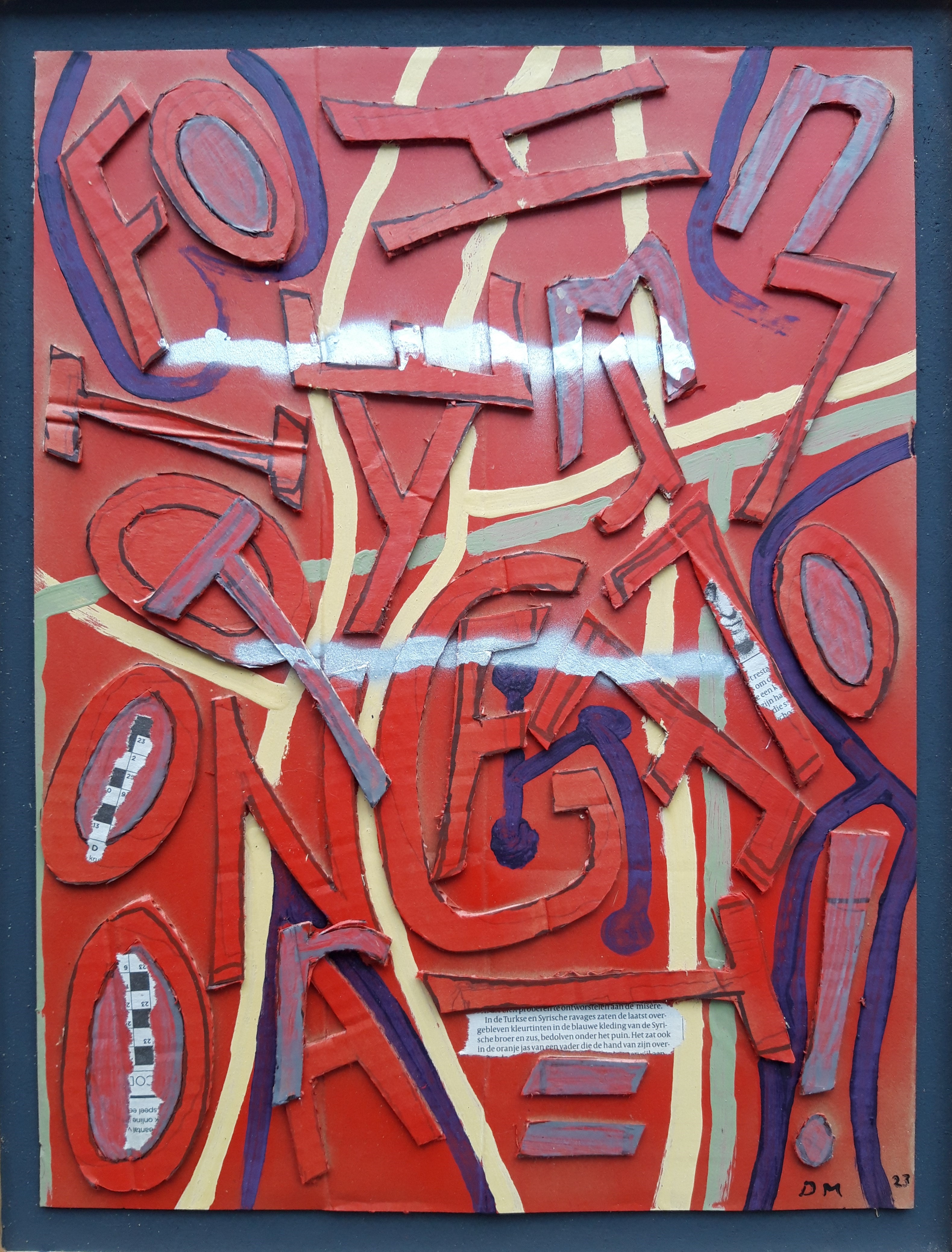
Finally, the letters cut from carton to serve as template for the painted banner, are assembled as collage with additional transformation.
Drager Meurtant, “Frontex – 3”, 2023
NDSM-Fuse ON THE RUN (OP DE VLUCHT), September 1st 2023 – January 28th, 2024.
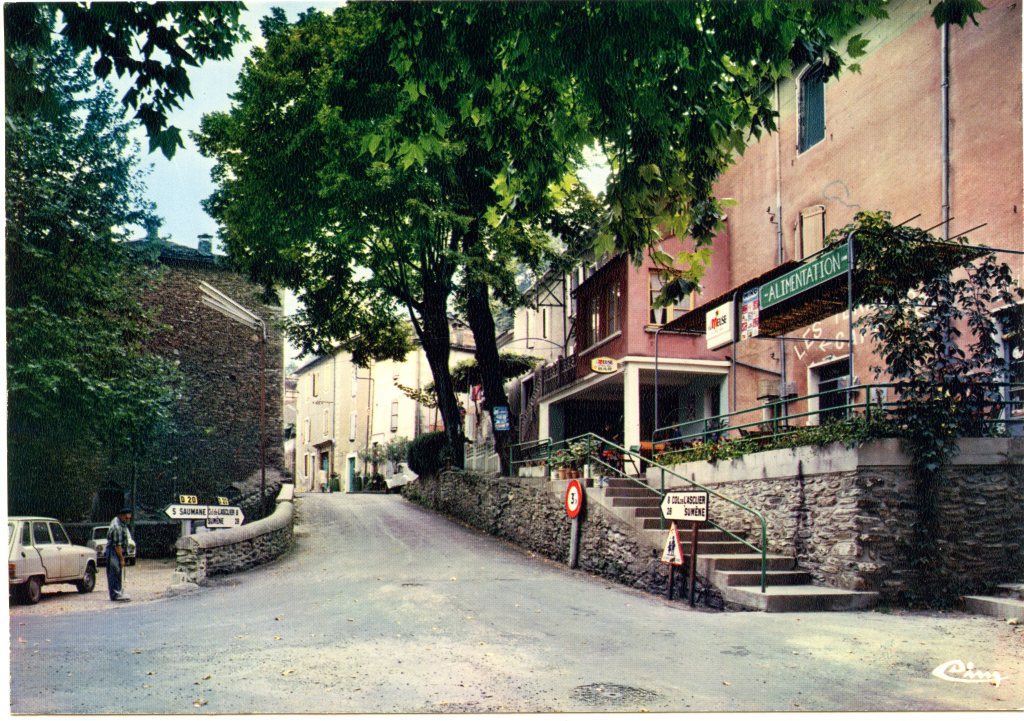
Up until about thirty years ago, villages in France each had their ‘alimentation*’, ‘boulangerie’, boucherie and one or more cafes. In larger villages – as in cities – there was also the ‘quincaillerie’.
Elder men sat on benches smoking pipe while looking at others playing ‘petanque’.
Alimentation in Les Plantiers, (Departement Gard,) about 1980, postcard
As prehistory tells, the earliest humanoid presence in France dates from > 1.5 million years. Up untill 5.000 years ago pockets of human inhabitation consisted of small settlements. In the neolithic period (circa 4500-1700 bc) agriculture was adopted, with parallel development of appropriate tools to work the land and store produced foods. As such, potteries became established. Settlements increased in size.
The following era’s were defined – in archeological terms – by the metal that dominated in tools (and ornaments), with iron, copper, followed by bronze. A major change occurred with the colonization of France (‘Gaul’) by the Roman Empire, of which period many remains are still scattered across the country.
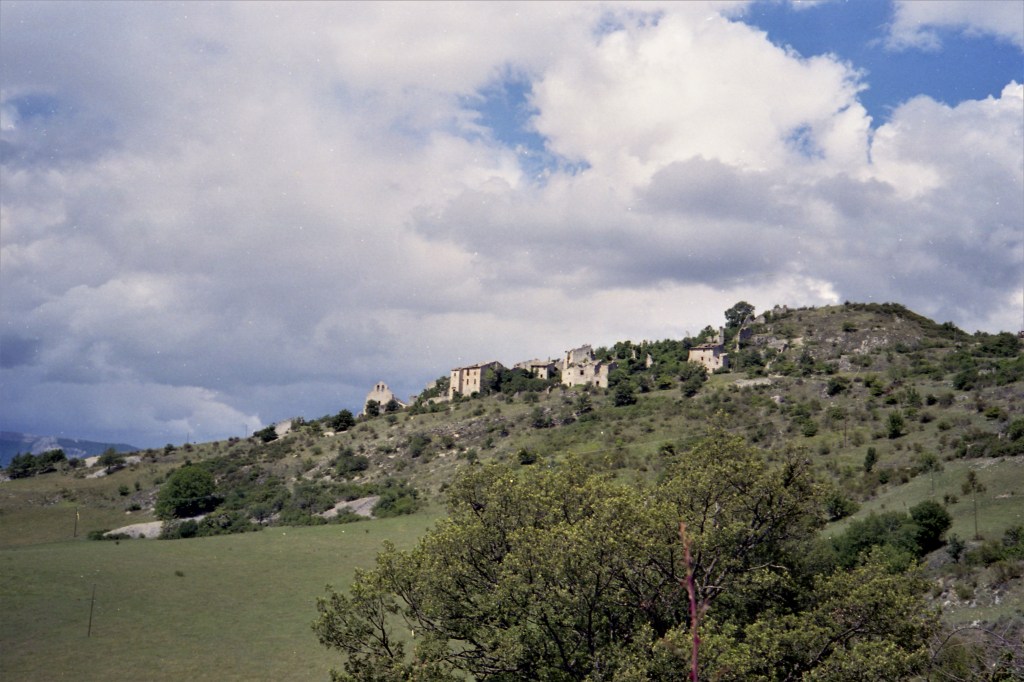
With industrialization in the 19th century the rate increased at which urbanization occurred – with people departing from agricutural regions, a process that continues up to today. Examples of ‘villages abandonnées’ are found all over France’s rural areas. In some regions erosion added to the abandonment of villages.
Abandonned village in The Provence, ca 1980, photo DM
In addition, there occurred the devastating effect of “La grande Guerre” (WW-I), in particular in the north of France. Whole villages were destroyed to the ground, never to be rebuild. In the area above Verdun several of these destroyed villages (‘villages detruits’) can be found. In villages that survived – which ever the size – memorials were raised incised with long lists of victims.
Mort pour la France (Grancey le Chateau, Dep. Côte d’Or) photo DM 2017
However, despite the fact that grenates and bodies were being dug up for decades after the war, life gradually resumed it’s normal course.
Farmer ploughing, Haute-Marne, photo DM 2017
Society in these areas for most of the 20th century still can be defined as people with their connection to their family, work, village, the church, the school, and trade at markets and shops. For travel – if not by car – many railways served to link villages and cities.
Gare de Veynes-Devoluy, (Dep. Hautes-Alpes), photo DM 1997.
Now in 2017
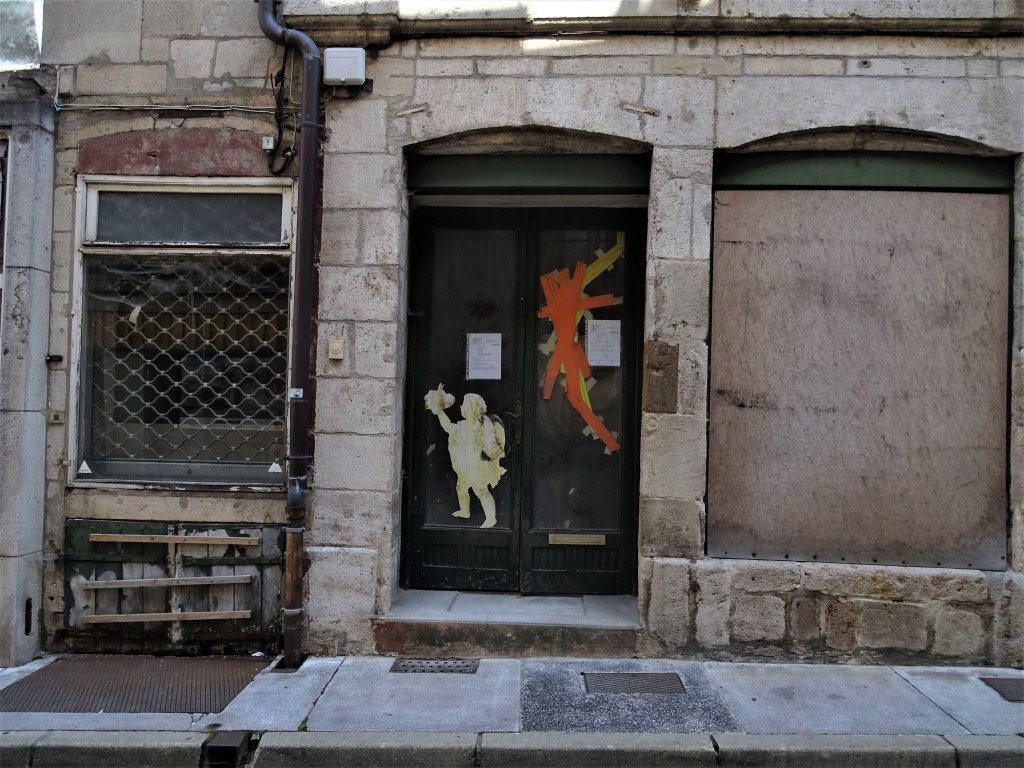
Many villages no longer have their ‘alimentation’ or even ‘boulangerie’. People must go to large shopping centers on the outskirts of larger cities.
Abandonned bakery (‘boulangerie’, in Langres, Dep. Haute-Marne), photo DM 2017.
In small cities like Langres, the same pressure closing smaller stores exists, but the population plus tourists serve to maintain the economy of others.
Boulangerie Maison Gallien, Langres, photo DM 2017
Yet, even in Langres this nice bakery, “Boulangerie Maison Gallien” is threatened with closure, since neighbours – unlike in previous times – now complain about the noise of the bakery at 4 o’clock in the morning. (sign on door: “Nuisances Sonores – une boulangerie en difficulté”, or “Noise Disturbences – a bakery in problems”, post from Le Journal de la Haute-Marne). Likely, ‘modern city people’ working from 8.30 till 17 hours, tolerate less than earlier inhabitants.
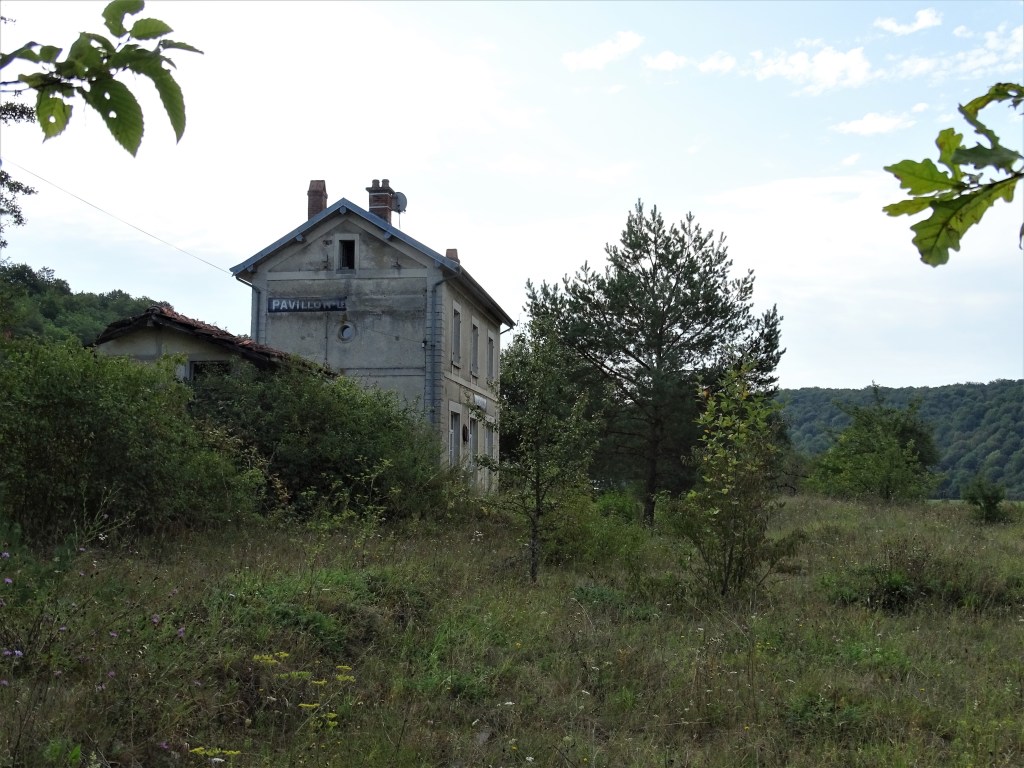
Many railroads have ceased to exist. Schools have closed or are threatened with closure. The ‘cementos’ of society crumbles. Foreigners (mostly dutch) buying houses for use during holidays stop decay of abandoned houses to some extent, but leave emptiness during many months in the year.
Grancey le Chateau-Neuvilles, Le Pavillon (Dep. Côte d’Or) . Abandonned railway station and former track. photo DM 2017
Perspective
The sometimes exorbitant prices of houses / appartments and of living in large cities such as Paris, plus the unhealthy environment (pollution) and the increased number of retired people are all factors that lead to a move out of these cities towards the country. The existence of rapid trains supports this option. For retailers of small shops, however, future remains uncertain.
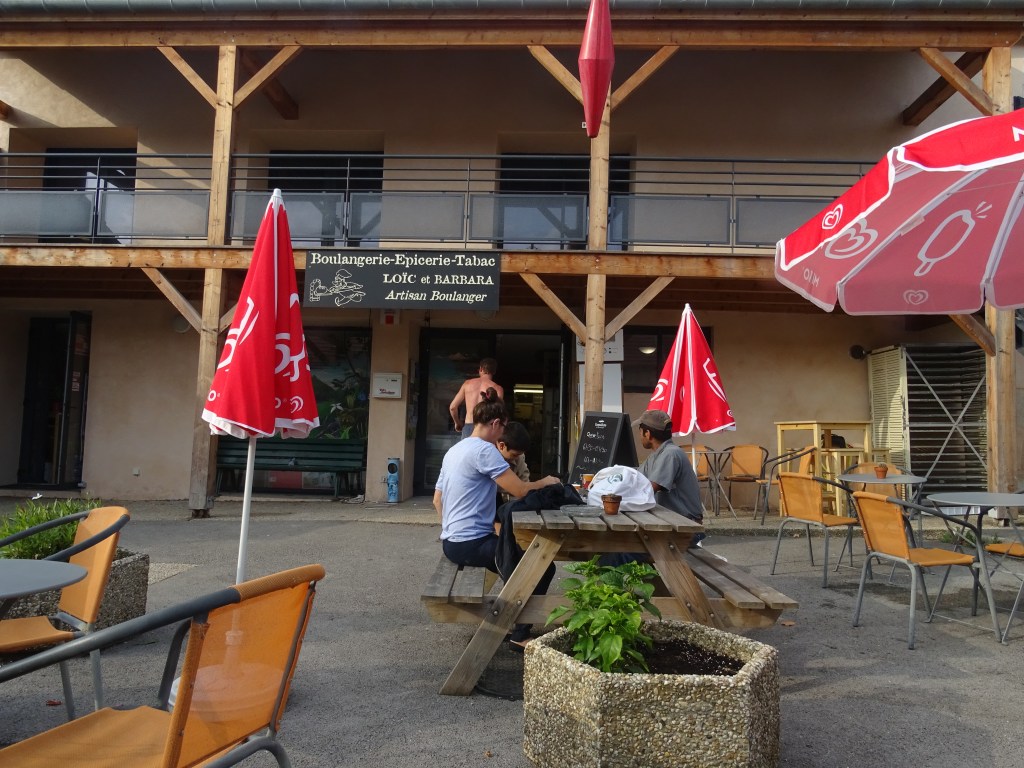
The presence of places of interest, like former Abbey of Auberive, now also Museum of Contemporary Art (focus on ‘independent art’) helps to maintain enterprises such as Boulangerie – Alimentation & Café de l’Abbatiale in Auberive. (Departement de Haute-Marne)
Boulangerie – Alimentation & Café de l’Abbatiale in Auberive, photo DM 2017
Note, added June 1st 2020
The COVID19 Corona-virus pandemie, that also struck France heavily, and led to a lock-down (including inability to move freely for > 1 km from home) for more than 2 months, might stimulate a move from the city to the country.
In countries like Greece, the visitor must rely on stones to get a grasp of history and important developments of culture.
During a short journey in May 2019, In the department of Pella, Macedonia, Greece, we followed signs indicating “Ancient Archeological Site of Petres”.
When arriving there, and having parked the rented car and after walking about 400 m, the most surprising elements to us, were ancient big jars, present in many houses, that had been installed to store water (photo 1).
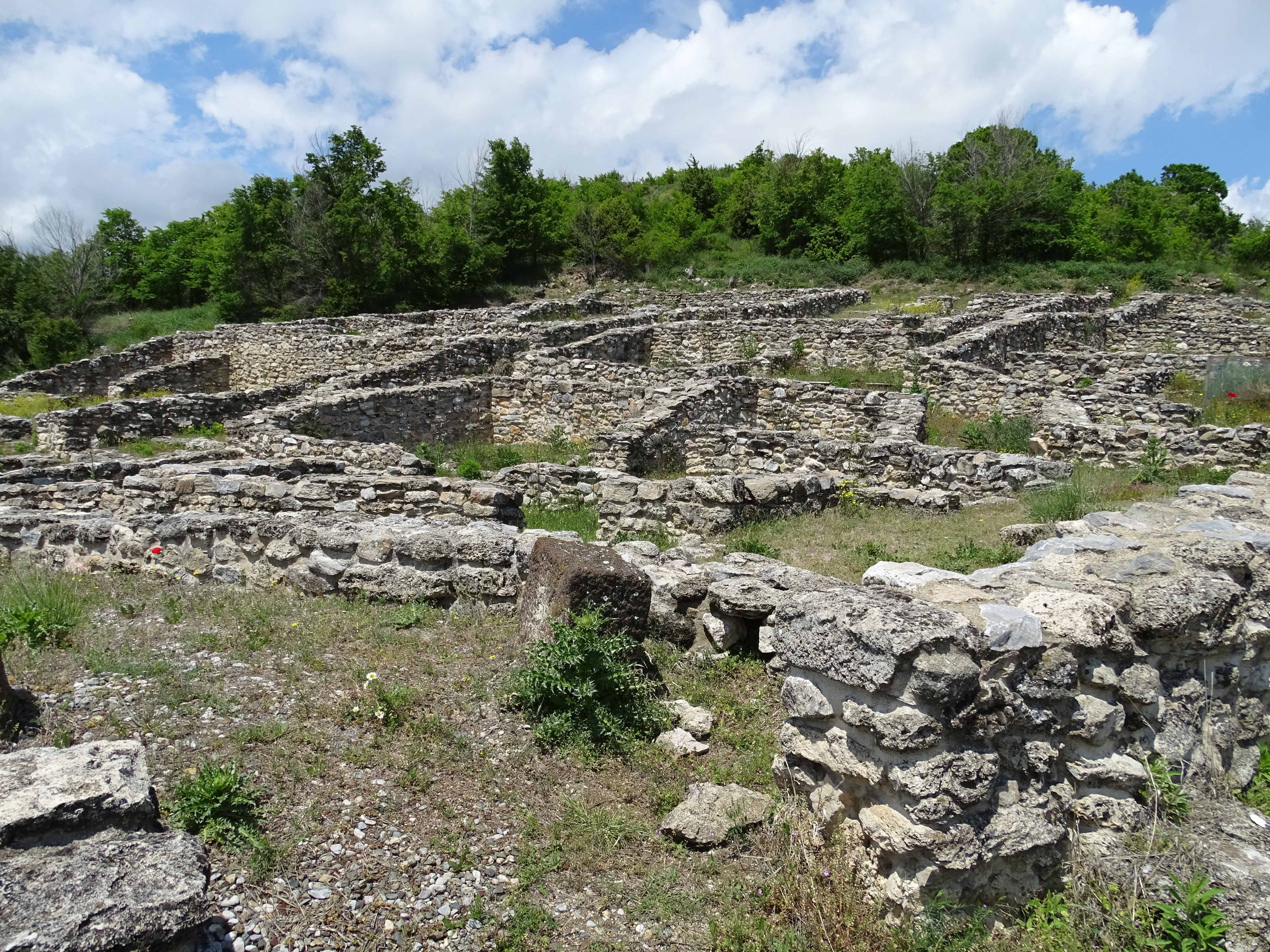
Looking at the plan of the small city, with rectangular houses, one starts to imagine people walking here, more than two thousand years ago. Discussing family affairs, the harvest, trade, threats… (photo 2).
The firm conclusion was: use talk, or writing, as social medium.
Information about the history of Ancient Petres:
“The ancient city occupies a natural mound to the NW of the village of Petres, in the region of Florina. Its total area reached 15-20 hectares and was protected by a fortification wall built of poros stone. The enclosed area included houses, and public buildings erected in a free layout, separated by streets, 2.5 m. wide. The city was founded in the 3rd century B.C. by Antigonos Gonatas, it flourished in the 2nd century B.C. and it ceased to exist in the 1st century B.C. It was again inhabited in the Roman period, but it moved to a different site.
The archaeological evidence leads to the conclusion that the city owed its development to its strategic position on the Egnatia Road and to its commercial exchanges with other Greek cities. The excavations of the site revealed useful information on the types of the private houses, which were continuously used in north-west Macedonia as late as the 19th century.
Excavations on the site were begun in 1982 and are still in progress, along with restoration and consolidation work of the ancient remains.
From time to time I check old emails, to see which of these at that moment has become obsolete and can be discarded. On some such occasions I may decide ‘to give it a try’: and will send an email to find out whether the connection still exists. And at the age past sixty, the occasions occur with increasing frequency on which the server responds with a text like ‘this address is not known at ‘YouMailMe-dot-Com’. Or, somewhat more striking, a reply comes with a text like this: “Thank you for your mail. My father died one year ago but we kept this address for a while, in order to inform those people we had not been able to locate to send a notice of his death.”
When posting photo’s on websites like www.flickr.com, I noticed another phenomenon typical of the digital era, expressed by the message on such website (or group within the website) that you and I visit, telling: “welcome <back> dear guest. And let us not forget the good work by Verena Ashley Connover (name invented by DM) who left us, but whose photos you still can find in the postings of our group”. Or, “Remember Verena, whose album we still cherish with joy”.
Some time ago I wrote a comment to an artist, via his website containing artwork that appealed to me. My words were aimed to express my appreciation, and a few weeks later were answered by a reply to my mailbox, telling that the artist’s son, out of esteem and admiration for his father, kept the website online for continued digital accessibility of his father’s artworks.
With graves in my country being excavated often at 50 years or even less after burial, one may wonder at which time the heirs of an individual might decide to stop such a website, or when welcoming messages like the above are erased/deleted.
My perception became more grounded, that a search nowadays on the web for signs of (life of) someone, with increasing frequency results in the impression that the person is indeed alive and kicking, whereas the truth is different.
The creation of a memorial
It is of course, an option to transform the website of someone that died, or the account of a deceased member on a social medium into a place to commemorate. When I searched the internet some months ago (April, 2016) with the words “a website to commemorate”, there was an immediate find.
And next, dear readers, I tested the web what it would produce for the words “death on the internet”, and no surprise, there is a Wikipedia page appearing. (https://en.wikipedia.org/wiki/Death_and_the_Internet).
In it, the phrase can be found “As the Internet age progresses it will come to a point where inactive accounts of deceased people will outnumber those of active users”.
And focus is on the position / attitude of several social media and large email providers, as to how these deal with the death of stakeholders.
For heirs and sometimes friends of a deceased, the responsibility arises how to deal with the digital inheritance, next to the need to organize a proper farewell of a friend or family-member.
The Wikipedia page mentioned above, even indicates the existence of organizations that safeguard one’s ‘digital inheritance’ and which only yield access to those persons that have been supplied by an ‘activation code’ by the holder during his/her lifetime. See it complimentary to the testimony you have arranged.
wired
The unknown death
The above situation, of people that at first sight may seem alive, but only their presence on the internet has remained while their physical presence has ended is paralleled by a gap that will persist for the next 10-20 years. And now I’m talking about people of the present time, that do not exist on the internet. They have no account. They do not belong to people of whom a company or newspaper will announce a in memoriam after their death. These may be schoolmates of me, that I search for traces of digital existence, and no such trace is to be found. And we tend to forget that some people have no digital existence.
This short notice has no motto, no advise. It is just aimed to express my surprise.
















 drager-meurtant