• About

drager-meurtant

~ The world is made up of elements, catched by light-writing or assemblage.

drager-meurtant

Category Archives: art

About light

01 Monday May 2017

Posted by dragermeurtant in art, kunst, poezie, Uncategorized

≈ 1 Comment

Tags

essence, essential, fotografie, gedicht, kunst, photography, poetry, poezie

Drowning / Verdrinking

DSC05498

When light falls / on the surface / it hesitates half a second / before drowning

Als licht valt / op het oppervlak / aarzelt het een halve seconde / alvorens te verdrinken.

(And a second thought / En een tweede overdenking)

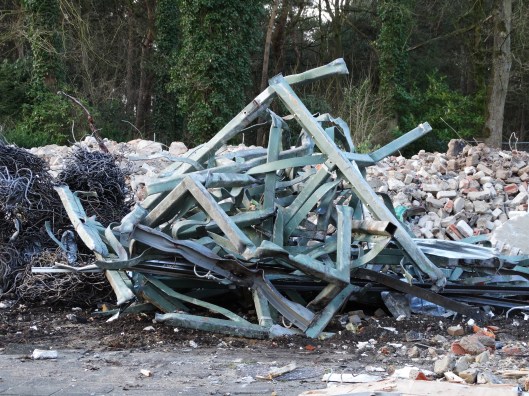
Piles / Stapels

DSC05892

One by one / I will withdraw / the words spoken / until this poem / is an empty hull.

Eén voor één / zal ik de woorden terugnemen / die zijn gesproken / tot dit gedicht / een lege huls is.

(And the last consideration for today / de laatste overdenking vandaag)

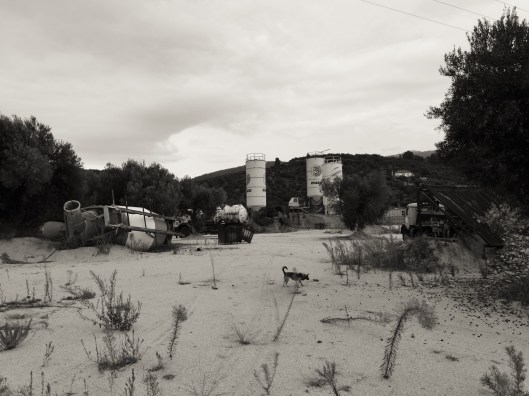
On Guard / Op Wacht

DSC03835

There is one dog / on guard. // And that is more / than enough.

Er loopt één waakhond. // En dat is meer / dan genoeg.

Inval nabij

17 Monday Apr 2017

Posted by dragermeurtant in art, Dada, poezie, street photography

≈ Leave a comment

Tags

Dada, donker, gedicht, poezie

Zacht zuigen tenen / aan de klefheid / van net gestort beton.

In trage tred / gaan gedachten / in het rond.

Afdrukken / malen stroom, / die voeten / grijs doet stollen.

De gang / van troebel / denken / trekt / strakke cirkels.

Alles wijst / op een doorbraak.

Crumble

(c) Drager Meurtant, ongeveer 2003; foto van 2015)

One poem – Eén gedicht

10 Monday Apr 2017

Posted by dragermeurtant in art, Uncategorized

≈ Leave a comment

Tags

collage, kunst, poetry, poezie

(in English)

Crossing

The images that cross / the web of / my experiences,

at times get stuck in / old scars, without / paying attention /

to gates or / prohibitory signs. //

Those images do not / shed light or give/ clarity. //

Those images burn / their shadow on / the projection of /

memories.


(In Nederlands)

Kruising

De beelden die kruisen / door het web van / m’n ervaringen, /

kunnen vastlopen in oude / littekens, zonder / acht te slaan /

op hekken of / verbodsborden / geplaatst uit lijfsbehoud. //

Die beelden geven geen / zicht of helderheid.//

Die beelden branden / hun schaduwen op / de projectie van /

herinneringen.


Collage:

A World cut to pieces – Een wereld aan stukken

DSCF0105

note: elements from travel guide of Yugoslavia (1980)

nota: elementen uit reisgids van joegoslavië (1980)

(c) Drager Meurtant, April 2017

Art by Assemblage: The Watt’s Experience

01 Monday Aug 2016

Posted by dragermeurtant in art, Dada, kunst

≈ Leave a comment

Tags

assemblage, independent art, installation, joshua tree desert, los angeles, noah purifoy, outdoor museum, Sabato Rodia, sam rodia, watt's towers, watts

(1) The Watt’s towers from Sabato ‘Sam’ Rodia

Sabato Rodia (1876-1965) arrived from Italy in the USA at 15 years of age, to join with his older brother who had immigrated earlier. In the USA people named Sabato ‘Sam’, or – according to some – ‘Simon’. When his brother died in a mining accident in Pennsylvania, where they lived and worked in quarries and as construction worker, Sam Rodia moved to Seattle. Here he married with Lucia Ucci and got three children, of whom one died. The couple separated 10 years later.

He then came to work as tile setter in California. There, in 1921, he achieved a piece of land in the community of Watts, part of Los Angeles, which he called “Nuestro Pueblo” (Our Town or Village). In his spare time he raised a wall and within the encircled space started to create an assembly of seven large towers, in themselves assemblages, of steel rebar and concrete with mosaics from tiles, broken ceramics, shells, and glass bottles.  To these towers he added pavilions, fountains and benches. The structures were coated with decorations in the shape of work tools, fruits and vegetables. Everything was done with simple hand tools and without the use of scaffold.

Rodia welcomed visits from members of the neighborhood and several marriage and other celebrations are said to have taken place under the towers. Motive for the building of these towers reportedly were, that he wanted to be engaged in a healthy and lasting project.

WATTS-1-jumbo-czwerwonka

Watt’s Towers – Overview 1, photo by Michael Czerwonka, photo as this appeared in NY Times Feb 7, 2011, with permission

Sam Rodia continued to work on the towers for over 25 years and then in 1954 he gave the lot to his neighbour and left to live elswhere. In 1959 two young film makers heard of the threat by local authorities to demolish the towers on the presumption these were a hazard. They – with other young artists – set up a Committee for Simon Rodia’s Towers in Watts, that despite lack of grand names succeeded in preserving the towers for the future. After proof was obtained that the towers were safe the Watt’s Towers were listed as national heritage in 1965 and 10 years later became an art center for the city.

Already around 1960 recognition came that Rodia had made a special art assemblage, from art professionals in academia. Yet, he died in Martinez without returning to Watts in 1954.

lucien-den-arends-wattstowers.jpg

Watt’s Towers – Overview 2, photo by Lucien den Arend, http://www.wattstowers.us, with permission

While preparing this essay, I encountred many nice photo’s on flickr. Some have been posted here (with permission) but I give you the consideration to follow the links yourself. One image from a scale model of the Watt’s Towers that was made by the architect Larry Harris – I think – enhances the perception of the project as you can see below.
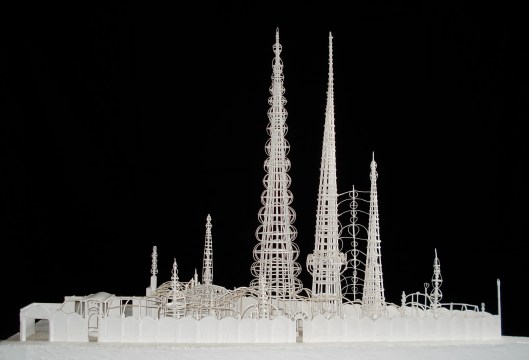
Larry Harris - scale model Watt's Towers large.jpg

Larry Harris – Scale Model of Watt’s Towers (1996-1997), from flickr, with permission

Details of the collage – assemblage art as created by Sam Rodia by use of parts of tiles, bottles etcetera, are seen in the following three images.

steve silverman watts tower detail-2.jpg

Watt’s Towers – detail 1, photo by Stephen Silverman, with permission (see album on http://www.flickr.com)

Steve Silverman Watts Tower detail.jpg

Watt’s Tower – detail 2, photo by Stephen Silverman, with permission
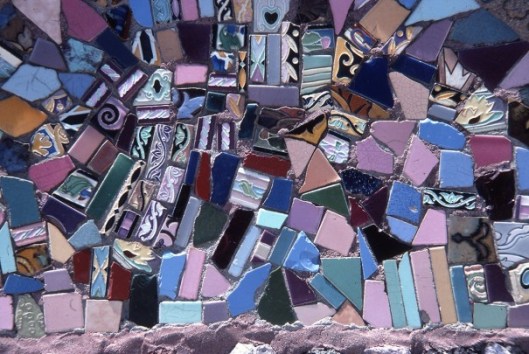
rodia watt's tower mosaic seymour rosen - Spaces.jpg

Watt’s Towers – detail 3 (tiles), by photo by Seymour Rosen (ca.1976), SPACES – Saving and Preserving Arts and Cultural Environments (www.spacesarchives.org), with permission

In 1962, the committee for Simon Rodia’s Towers in Watts, mentioned above, formed the Watts Tower Cultural Center that would offer art classes and exhibitions in which local inhabitants could take part. With the arrival in 1964 of Noah Purifoy as the first black director of the center, the committee hoped to realize a nucleus for community-based art in Watts. This community had changed much in demography following World War Two, after the influx of many African-Americans into this – in former years predominantly Mexican-populated area – and which at that time was economically depraved. A few years later these poor social circumstances were at the basis of major disturbances.

(2) The Watt’s rebellion

The African American artist Noah Purifoy (1917-2004) was teacher at this Watt’s Towers Art Center in 1965 when an arrest of a black motocyclist by a white policemen, – considered as injust by onlookers -, led to riots. These riots can be seen as result of long-term neglect, oppression and feeling by Watt’s inhabitants of injustice from the side of authorities. Between the 11th and 19th August hundreds of stores were looted, cars and buildings burned. After intervention of a large force of the National guard, 34 people were dead, over 1000 thousand injured and economic damage assessed as over 40 million USD. (Take some time and read extended testimony from artists like John Outterbridge in ref. 3).

Noah Purifoy saw the massive collective violance and together with fellow artists started collecting debris and rubble spread on the streets in the first days after violence started.

From the debris he and seven fellow artists (Judson Powell, Arthur Secunda, Gordon Wagner, Max Neufeldt, Ruth Saturensky, Debby Brewer) collected, they constructed assemblages / installations, collectively named 66 Signs of Neon, that were fitted from “fire-molded wood collided with smashed-in windows, burnt railroad-ties with scorched steel” (writing by Yael Lipschutz). The artists by use of this material originating from destruction, created an echo of the rebellion and an appeal to be constructive. From the resulting art-works the artists formed a landmark group exhibition about the rebellion that traveled to nine venues between 1966 and 1969. This exhibition was in line with the increased attention for street art and – life in photography and creative art and for the approach by people like Marcel Duchamp to transfer found objects into art.
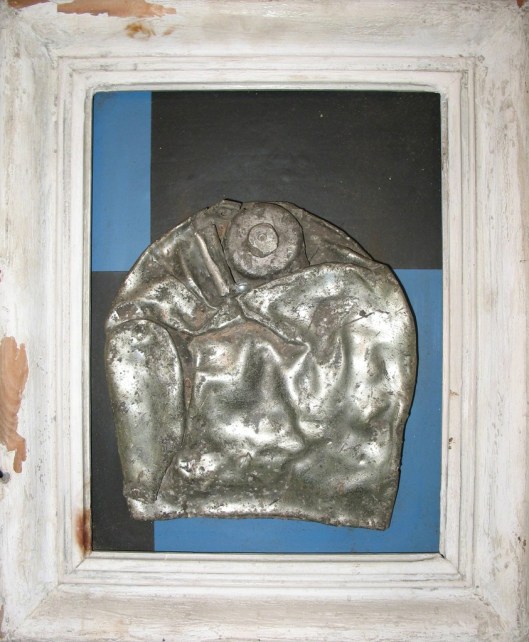
noah purifoy pressure, 1966

Noah Purifoy – Pressure, c1966. A metal can scathed by the fire during the ‘Watt’s riots. the pereception of destruction is enhanced by putting this found object in the white frame. Image found at website from the Hammer Museum (www.hammer.ucle.edu), posted with permission of the Noah Purifoy Foundation

(3) The Watt’s Tower Art Center

Noah Purifoy had a professional training in social work and had a strong belief in the healing power of art education. In an interview with Richard Cándida Smith, the artist shared his strong motive:

“Within [each person] there’s a creative process going on all the time, and it’s merely expressed in an object called art. One’s life should also encompass the creative process. We were trying to experiment with how you do that, how you tie the art process in with existence” (referred to in ref 4).

With his colleague Judson Powell and with a basis at the Watt’s Tower Art Center, they were determined to increase perspectives for – in particular younger – people of Watts. With their belief that art could transform consciousness, and with the artworks created from found debris, it was to become clear that creativity can be exploited by use of the cheapest material.

In following years, Purifoy as chair of a committe of education in LA instigated a state-supported art in education program “California Learning Design – that ran at nine schools in the state. Artists were employed half-time for one year at such a school and together with regular teachers they shaped a program of teaching into which students, artists, and the community came to interact by physically ‘mixing these elements’.

(4) Noah Purifoy in Joshua Tree

Noah-Purifoy-Outdoor-Desert-Art-Museum-of-Assemblage-Sculpture_49.jpg

Noah Purifoy Outdoor Desert Art Museum of Assemblage, Sculpture <Welcome> photo by Ed Glendinning (#48-15), found at http://www.edglenphoto.com, with permission

In the late 1980’s, after eleven years of public policy work for the California Arts Council, where Purifoy initiated programs such as Artists in Social Institutions, bringing art into the state prison system, Purifoy moved his practice to the Joshua Tree in the Mojave desert. He lived there for the last fifteen years of his life, while lacking a pension – and created ten acres of large-scale sculpture constructed entirely from junked materials. The members of the surrounding community as well as entrepreneurs gave him discarded material, or gear that (legally) no longer was accepted in construction. The large scuptures he made, were meant to communicate with the environment, both nearby as well as the landscape at distance. The wear-and-tear of heat / cold plus strong wind became part of the time-line of the assemblages. (See images and the movie on vimeo (https://vimeo.com/397505164).

Noah-Purifoy-Outdoor-Desert-Art-Museum-of-Assemblage-Sculpture_12.jpg

Noah Purifoy Outdoor Desert Art Museum of Assemblage – Sculpture, photo by Ed Glendinning (# 12-15), with permission

Noah-Purifoy-Outdoor-Desert-Art-Museum-of-Assemblage-Sculpture_16.jpg

Noah Purifoy Outdoor Dsert Museum of Assemblage – Sculpture, photo by Ed Glendinning (#16-15), with permission.

The large scuptures Noah Purifoy made in the Joshua Tree Desert, were meant to communicate with the environment, both nearby as well as the landscape at distance….
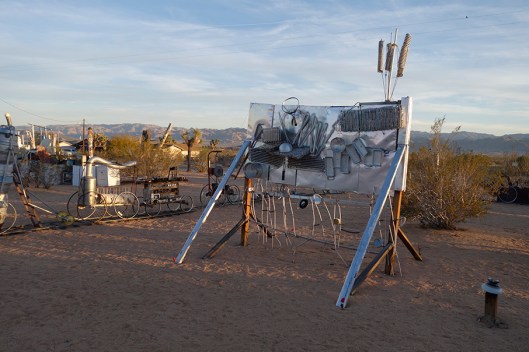
Noah-Purifoy-Outdoor-Desert-Art-Museum-of-Assemblage-Sculpture_39.jpg

Noah Purifoy Outdoor Desert Art Museum of Assemblage – Sculpture, photo by Ed Glendinning (#38-15), with permission

As written in Richard Cándida Smith article (“Learning from Watt’s Towers: Assemblage and Community-based Art in California”): “One plumbing contractor donated several dozen toilets that could no longer be installed in California due to changed water-conservation law.”

Noah-Purifoy-Outdoor-Desert-Art-Museum-of-Assemblage-Sculpture_18

Noah Purifoy Outdoor Desert Art Museum of Assemblage – Sculpture, photo by Ed Glendinning (# 18-15), with permission

 And, the last photo chosen by me – being interested also in (abstract) collage, and which might underscore the interest Noah Purifoy had in art from the Dutch painter Mondrian…

Noah-Purifoy-Outdoor-Desert-Art-Museum-of-Assemblage-Sculpture_11.jpg

Noah Purifoy Outdoor Desert Art Museum of Assamblage – sculpture (collage), photo by Ed Glendinning (#11-15)

(5) Notes:

(a) In February 2016 (running till August) it was memorized that 50 years ago the Watt’s rebellion took place under the event title “50 years later and I still can’t breath”.

(b) citations provided with permission by respective authors.

(text by Mrs Yael Lipschutz accessed in September 2015, no longer available at the internet as far as I could see by search on July 31st 2016.)

(c) There is still need to support the preservation of the Watt’s Towers. Let us hope support from LA City will be stronger in the next year. http://spacesarchives.org/blog/2016/03/25/act-now-support-the-watts-towers-candidacy-for-unesco-world-heritage-site-status/

(6) Advise for further reading:

For more views and images of the Watt’s Towers and the Noah Purifoy Outdoor Dserert Art Museum of Assemblage Sculpture visit the links containing texts and many more photographs:

(1) Thomas Pynchon. “” A Journey into the Mind of Watts”, NY Times June 12, 1966 http://www.nytimes.com/books/97/05/18/reviews/pynchon-watts.html?_r=1

(2) Richard Cándida Smith. “Rodia, Simon“; http://www.anb.org/articles/17/17-01372.html; American National Biography Online Feb. 2000.
Copyright © 2000
American Council of Learned Societies. Published by Oxford University Press.

(3) Richard Cándida Smith. “Learning from Watts Towers: Assemblage and Community-based Art in California” Oral History, Autumn 2009: pp 49-56. http:// history.berkeley.edu/sites/default/files/Learning%20from%20Watts%20Towers.pdf

(4) Richard Cándida Smith. “The Modern Moves West: California Artists and Democratic Culture in the Twentieth Century”. University of Pennsylvania Press, Philadelphia, 2009, on Rodia: pp 45-54, on Purifoy: pp 154-181.
(5) Haggerty Museum of Art Staf : “Watts: Art and Social Change in Los Angeles 1965-2002“, 2003. http://www.marquette.edu/haggerty/documents/WATTS_catalogue.pdf

(6) Cameron Shaw. “Make Art not War. Watts and the Junk Art Conversation”, November 2010, East of Borneo. http://www.eastofborneo.org/articles/make-art-not-war-watts-and-the-junk-art-conversation

(7) Thomas Harrison. “Without precedent: The Watt’s Towers”, California Italian Studies 1, 2010. http://escholarship.org/uc/item/3v06b8jt

(8) Adam Nagourney. “A hidden treasure struggles in Los Angeles“, NY Times, Feb 7, 2011. http://www.nytimes.com/2011/02/08/us/08watts.html?_r=0

(9) Rubén Martínez. “Assembly required: the desert cure – the transformative art of Noah Purifoy”. Boom: A Journal of California, vol 2, Summer 2012. http://rubenmartinez.la/wp-content/uploads/2012/11/Boom-Purifoy-Column1.pdf

(10) Tanja M. Laden: “Junk Dada: The stories behind Noah Purifoy’s Joshua Tree Sculptures”, September 2015; http://www.kcet.org/shows/artbound/junk-dada-the-stories-behind-noah-purifoys-joshua-tree-sculptures

(11) Julia Felsenthal. “Noah Purifoy’s “Junk Dada”is an Art Show for the Post-Ferguson World”, June 15, 2015. http://www.vogue.com/13270774/noah-purifoy-lacma-junk-dada/

(12) Katie Grinnan. “Material Communication: Noah Purifoy at LACMA”. X-tra Contemporary Art Quarterly, Spring 2016, Vol. 18, no 3. http://x-traonline.org/article/material-communications-noah-purifoy-at-lacma/

Please also visit:

http://www.lacma.org/sites/default/files/Noah-Purifoy-Media-Advisory-2.4.15.pdf

http://www.wattstowers.org/

http://www.wattstowers.us/

http://noahpurifoy.com

http://www.cityprojectca.org/videos: several movies about the importance to save the Watt’s Towers.

http://www.edglenphoto.com

http://www.spacesarchives.org
Dadaglobe Reconstructed

15 Monday Feb 2016

Posted by dragermeurtant in art, Dada, kunst, Uncategorized

≈ Leave a comment

Tags

Dada, Dadaglobe, exhibition, Kunsthaus, reconstruction, Zürich

In Kunsthaus, Zürich, Switzerland a remarkable exhibition is held from February 1st to May 1st, 2016.One-hundred years after one of the founders of DaDa, Trstan Tzara, aimed to create a book “DadaGlobe” with contributions from many dada artists, a reconstruction has been accomplished.

Background

With the 19th century increase in industrialisation and in migration to cities plus the enhanced nationalism in Europe and elsewhere there was more tension in society, which was also articulated by artists such as the ‘futurist’ Filippo Tomasso Marinetti. The call to get rid of existing structure in language and art by art movements like futurism, and in different direction, by kubism, anticipated Dadaism.

At the start of WW-One, several artists who had fled from being drafted into the military or were resident in Zürich assembled in a movement of protest in this city in Switzerland. They detested the role of the establishment / authorities who were responsible for – as Richard Huelsenbeck later, in 1920, wrote – “the massing <of> men in the trenches of Northern France and giving them shells to eat”.

Hans (or Jean) Arp came from the Elsace, a repeated playground for German and French nationalistic frenzy. With Hugo Ball and Richard Huelsenbeck, both german, and the rumenian Tristan Tzara and Marcel Janco they founded Dada at Cabaret Voltaire, a small theatre started in February 1915 by Hugo Ball and his friend Emmy Hennings.

A prominent feature of dadaist aesthetic was its ridicule of materialistic and nationalistic stance, and it was expressed in poetry, prose, painting, sculpture and performance. The mediums of collage and of assemblage, that had surfaced a while earlier, were embraced with ardor.

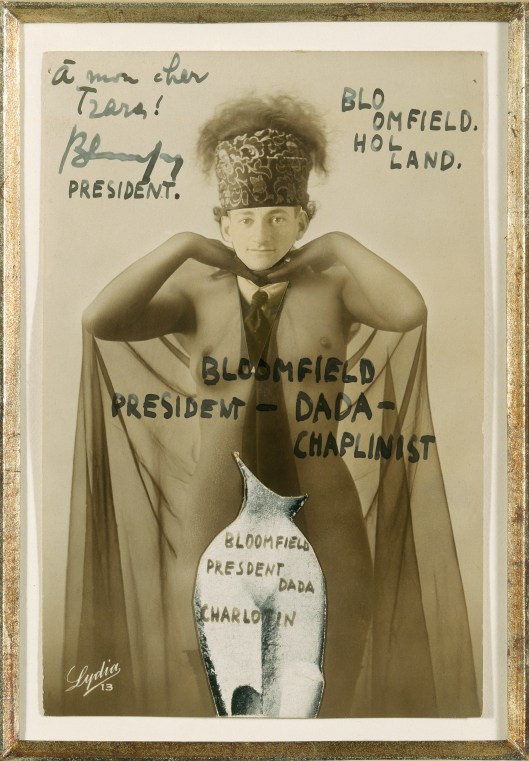
Blumenfeld Erwin_Bloomfield President Dada Chaplinist.jpg

Erwin Blumenfeld: “Bloomfield, President-Dada-Chaplinist”, 1921
Collage mit braun-getönten Silbergelatine-Fotoausschnitten (Portrait Blumenfelds) über Silbergelatine-Foto-Aktpostkarte, mit Rasterdruck und Tinte, 13,4 x 8,8 cm
Kunsthaus Zürich, © Nachlass Erwin Blumenfeld


While often seen as the first vocalization of babies, the word Dada – as the dadaists tried to explain -, means nothing or everything. As Hugo Ball mentioned “All the words are other people’s inventions. I want my own stuff, my own rhythm, and vowels and consonants too, matching the rhythm and all my own” (first Dada soiree, Zürich 14th July 1916). Later attributions are that the word Dada comes from French, from a children’s word for hobbyhorse, the name being arbitrarily chosen, or from romenian da-da meaning yes-yes (https://en.wikipedia.org/wiki/Dada)

ernst_max_le_rossignol_chinois
Max Ernst, Chinesische Nachtigall, 1920, Collage und Tusche auf Papier, 12,5 x 9 cm, Musée de Grenoble, © 2016 ProLitteris, Zürich


A major force in Dada was Tristan Tzara. Exemplary is his statement about poetry:

TO MAKE A DADAIST POEM
Take a newspaper. / Take some scissors. / Choose from this paper an article of the length you want to make your poem. / Cut out the article. / Next carefully cut out each of the words that makes up this article and put them all in a bag. / Shake Gently. / Next take out each cutting one after the other.
Copy conscientiously in the order in which they left the bag. /
The poem will resemble you. / And there you are—an infinitely original author of charming sensibility, even though unappreciated by the vulgar herd.

tzara_portrait_for_dadaglobe

Unbekannter Fotograf: Portrait von Tristan Tzara, um 1920
Silbergelatineabzug, 11,4 x 18,6 cm, Collection Chancellerie des Universités de Paris, Bibliothèque littéraire Jacques Doucet, Paris
 (The following paragraph is taken from the press briefing by Kunsthaus Zürich)

100 ARTWORKS, 100 DOCUMENTS

With contributions by artists and writer s from seven countries, many of whom created new works for his publication, co-founder of Dada and originator of the ‘Dadaglobe’ project Tristan Tzara (1896-1963) set out to present the apotheosis of Dada as a literary and artistic movement of international scope and to document it for posterity. ‘Dadaglobe’ was envisaged as a paean to the work of art in reproduction; but financial and organizational difficulties meant that the book never saw the light of day. The result is a void where a magnum opus should be – at the heart of Dada’s reception and the artistic production of the avant-garde in general. Now, a hundred years after the foundation of Dada, an exhibition and a comprehensive publication aim to fill that void. ‘Dadaglobe Reconstructed’ turns the analytical spot light on this notoriously restless and virtually unclassifiable art movement. It writes a fundamental, hitherto missing chapter in the history of modernism, in which Tzara’s Dada legacy shapes the vocabulary of artistic discourse.


hausman_raoul_p

Raoul Hausmann, P, um 1920-1921 Collage mit bedrucktem Papier und Tinte, 31,2 x 22 cm Hamburger Kunsthalle, Kupferstichkabinett © 2016 ProLitteris, Zürich

To honor the Kunsthaus curators and contributing artists / musea / collections with the establishment of the DadaGlobe Reconstruction, I will contribute – on the worldpress webpage only – my assemblage “Kaleidokopus”

paleidokopus-2.jpg

Paleidokopus: the movement / is slantwise / cautious / and under guidance. // Threat can come / from all sides. // Fear feeds mania, / and reason / does not allay / thirst.

Assemblage, wood, metal, paint, 38 x 23 x 53cm, © drager meurtant, 2014 (more at http://www.meurtant.exto.org)

Literature:

Richard Huelsenbaeck: En Avant Dada: A History of Dadaism, 1920, in Robert Motherwell, editor, The Dada poets and painters, Anthology, 2nd ed. Belknap, Harvard University Press, Massachusetts, London, 1951.

Dada and Surrealism: Texts and Extracts. http://pers-www.wlv.ac.uk/~fa1871/surrext.html

Samantha Kavky: Max Ernst’s Post-World War I Studies in Hysteria; The Space Between Volume VIII:1 2012 pp 37-63, http://www.monmouth.edu/the_space_between/articles/SamanthaKavky2012.pdf

Acknowledgement: the author thanks Kunsthaus Zürich for enabling use of text and images in this blog.

Relevancy of art or artists

11 Friday Sep 2015

Posted by dragermeurtant in art, kunst

≈ Leave a comment

Tags

art-with-a-mission, conservering, degenerate-art, entartete-kunst, relevancy-of-art

The relevancy of art or artists

In Hyperallergic (digital newsletter) a comment was written by Jillian Steinhauer with the title “Behold Nazi Postcards from the Infamous Degenerate Art Show” on November 26, 2014

(see: http://hyperallergic.com/165346/behold-the-nazi-postcards-from-the-infamous-degenerate-art-show/)

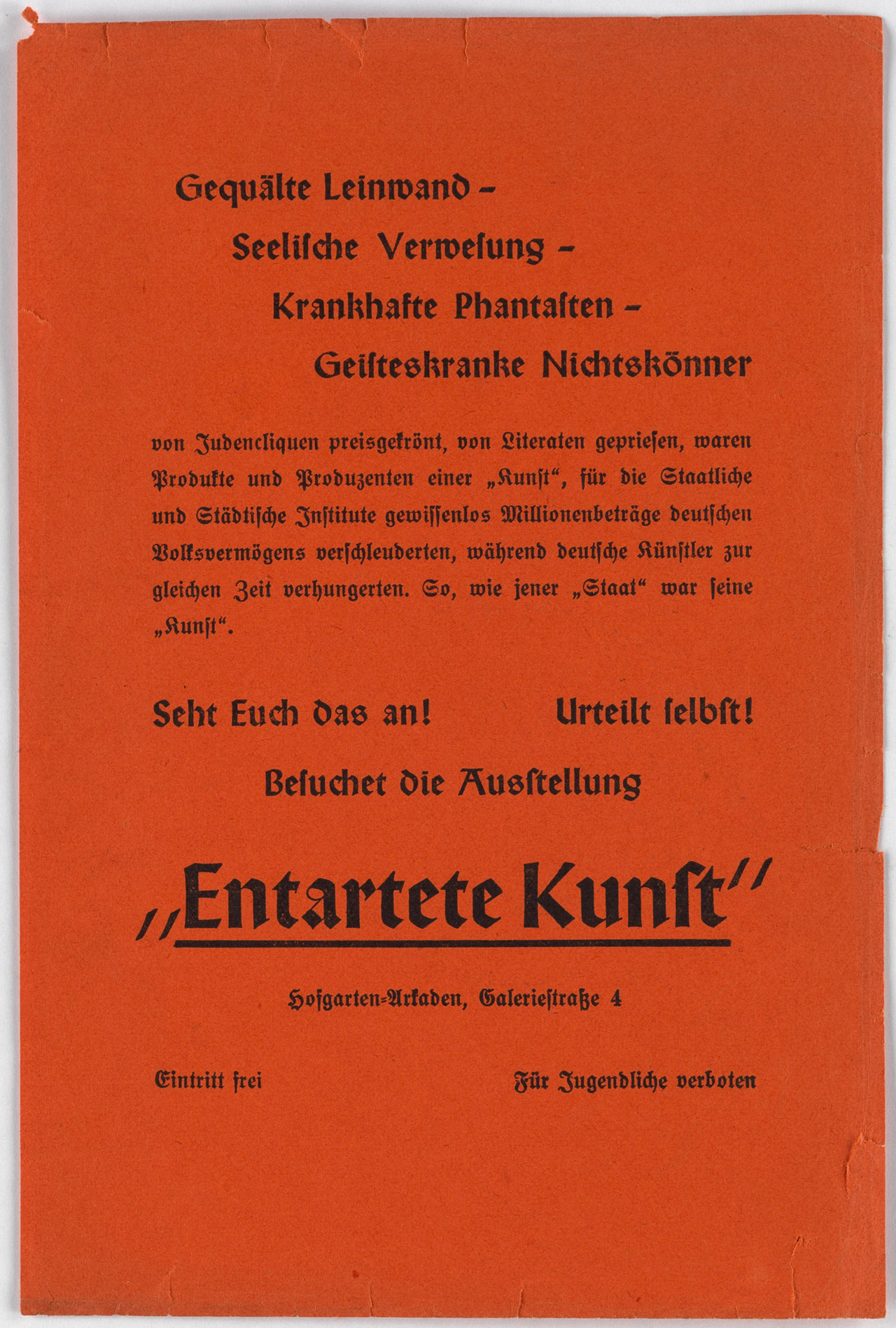
Poster Entartete Kunst

Jillian Steinhauer reacts to an announcement* of the auction of items from the Interbellum, namely 5 postcards displaying art as shown at the exhibition Entartete Kunst in München and other German and Austrian museums in 1938 plus 5 photographs of moments during the opening of one of these exhibitions and a poster (broadside).

*“The Degenerate Art Show postcards, broadside, and photographs will be sold together, as lot 133, in Swann Auction Galleries’ Vernacular Imagery, Photobooks, & Fine Photographs sale, on December 11, 10:30am.”

The author rightfully states that the viewer must look beyond an innocent display or surface, that postcards often present, since here the dark meaning of the views and subsequent action of the nazi authorities is not outspoken.

The postcards, the essay tells, were “apparently shot by Heinrich Hoffmann, Hitler’s chief photographer, (and) are notably simple: three of them show individual “degenerate” artworks, one the building’s exterior, the last an installation view.

Jillian Steinhauer adds “The Nazis, one supposes, fell into the usual trap: they expected everyone to see it their way, no added explanation or convincing necessary. These disgusting, offensive artworks would speak for themselves. Today they still do — only they’re telling a vastly different story.

Display of 'Entartete Kunst'

photo of art on display in Berlin at one of the exhibitions on “Entartete Kunst”

– – – – – – – – – – – – – –

Drager Meurtant is rather allergic to trends and powers in current society pushing artists to be politically correct. Having seen several expositions in 2014 memorizing art in Wold War One and the developments in the so-called Weimar Republic and subsequent take-over by nazis, he commented to the posting in Hyperallergic:

“With time, every wound will come to it’s end, leaving a scar, an income to reconstructive surgeons, or a dead body. we visited a remarkable exhibition in Soest (Museum Wilhelm Morgner, Sauerland, Germany) placing art (that had not been destroyed) by ‘Entartete Künstler” opposed to some artists that were enthousiastic followers of the NSDAP. The latter had not been possible for a long time in Germany. It is a good thing these postcards can now be seen as oddities. But to some, seeing these, the scar will itch, says drager meurtant”

listen

Photograph of “Listen”, assemblage by Drager Meurtant

text to assemblage:

Listen: If I listen / and hear no sound / or only the sound / that is not. // Than I whisper / my bitterness / in the ear of my / alter ego. // But what to say / to someone with / gauze before the eyes.

(November, 2014)

Newer posts →

Subscribe

  • Entries (RSS)
  • Comments (RSS)

Archives

  • February 2026
  • January 2026
  • November 2025
  • October 2025
  • September 2025
  • August 2025
  • July 2025
  • June 2025
  • May 2025
  • April 2025
  • March 2025
  • February 2025
  • January 2025
  • December 2024
  • November 2024
  • October 2024
  • September 2024
  • August 2024
  • July 2024
  • June 2024
  • May 2024
  • April 2024
  • March 2024
  • January 2024
  • September 2023
  • July 2023
  • April 2023
  • November 2022
  • June 2022
  • May 2022
  • February 2022
  • December 2021
  • September 2021
  • July 2021
  • April 2021
  • March 2021
  • January 2021
  • December 2020
  • November 2020
  • October 2020
  • June 2020
  • March 2020
  • February 2020
  • January 2020
  • December 2019
  • October 2019
  • August 2019
  • June 2019
  • May 2019
  • March 2019
  • August 2018
  • March 2018
  • December 2017
  • September 2017
  • August 2017
  • July 2017
  • June 2017
  • May 2017
  • April 2017
  • January 2017
  • August 2016
  • February 2016
  • September 2015
  • May 2015

Categories

  • abstract
  • animal
  • archeology
  • art
  • Art competition
  • assemblage
  • creation
  • Dada
  • death
  • Decay
  • defense
  • destruction
  • development
  • exhibition
  • Figurative art
  • France
  • graphics
  • Greece
  • History
  • houses
  • inconspicious
  • inside
  • installation
  • internet
  • italy
  • kunst
  • landscape
  • Le Pays
  • Mailart
  • mental health
  • mountain hike
  • mushrooms
  • nature
  • natuur
  • outdoor
  • painting
  • philosophy
  • photography
  • poem
  • poetry
  • poezie
    • poetry
  • retirement
  • river
  • rocks
  • society
    • demography
  • Spain
  • stones
  • stray-cats
  • street photography
  • street-photography
  • structure
  • tentoonstelling
  • travel
  • Uncategorized
  • unrest
  • Urban nature

Meta

  • Create account
  • Log in

Blog at WordPress.com.

  • Subscribe Subscribed
    • drager-meurtant
    • Join 44 other subscribers
    • Already have a WordPress.com account? Log in now.
    • drager-meurtant
    • Subscribe Subscribed
    • Sign up
    • Log in
    • Report this content
    • View site in Reader
    • Manage subscriptions
    • Collapse this bar
 

Loading Comments...